Converters
Unit conversion without mistakes
In 1999 a NASA spacecraft was lost at Mars because one team used pounds of force and another used newtons. Unit mistakes are not just a homework problem. Fortunately one simple method prevents nearly all of them.
Multiply by one
A conversion factor is a fraction worth exactly 1, because the top and bottom are the same amount: (100 cm / 1 m) or (1 m / 100 cm). Multiplying by 1 never changes a value, only its units. Choose the version that makes the old unit cancel.
Convert 3.2 m to centimetres: 3.2 m x (100 cm / 1 m) = 320 cm. The "m" on top cancels the "m" on the bottom, leaving cm. If the units do not cancel, you used the fraction upside down, and you find out before you get the wrong answer.
Chaining factors
For bigger jumps, chain several factors. 60 miles per hour in metres per second:
60 mi/h x (1,609.344 m / 1 mi) x (1 h / 3,600 s) = 26.8 m/s. Each fraction cancels one unit until only m/s is left.
Metric prefixes do most of the work
| Prefix | Means | Example |
|---|---|---|
| kilo (k) | x 1,000 | 1 km = 1,000 m |
| centi (c) | ÷ 100 | 1 cm = 0.01 m |
| milli (m) | ÷ 1,000 | 1 mg = 0.001 g |
| micro (µ) | ÷ 1,000,000 | 1 µm = 0.000001 m |
Watch out for squares and cubes
1 m = 100 cm, but 1 m² is 10,000 cm², because a square metre is 100 cm by 100 cm. And 1 m³ is 1,000,000 cm³. Square the factor for area and cube it for volume. Handily, 1 cm³ is exactly 1 mL, and 1,000 cm³ is a litre.
The handful of links worth memorising
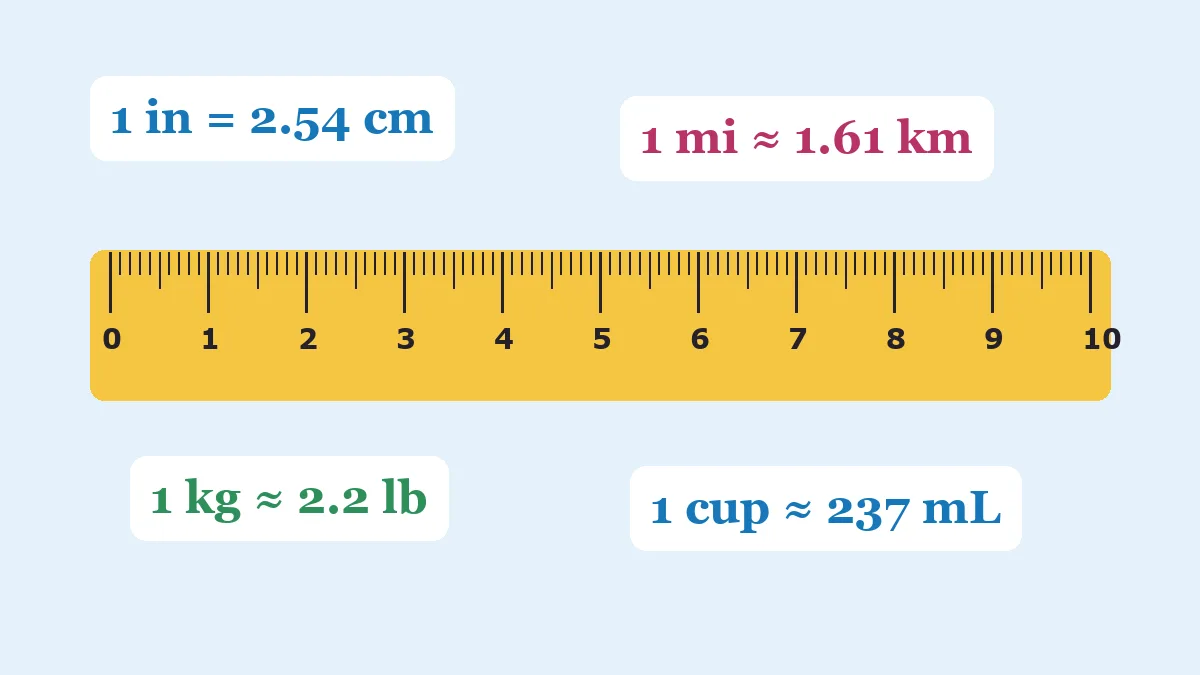
- 1 inch = 2.54 cm (exact)
- 1 mile ≈ 1.61 km
- 1 kg ≈ 2.2 lb
- 1 US gallon ≈ 3.79 L
Always sense-check
Converting to a smaller unit should give a bigger number (2 m = 200 cm), and to a bigger unit a smaller number. If your answer moves the wrong way, the fraction is upside down.
More explainers
 DatesCalendar maths: counting days, weeks and agesWhy counting days between dates trips people up, the "fencepost" problem, how leap years work, and quick methods for ages and countdowns.
 ConvertersRoman numerals explainedHow Roman numerals work: the seven symbols, adding and subtracting, the six subtraction pairs, reading years like MCMXCIX and where Roman numerals still appear today.
 ChanceProbability basics with dice and coinsLearn probability with dice and coins: favourable over total outcomes, and versus or, the complement trick, independent events and the gambler's fallacy.