Dates
Calendar maths: counting days, weeks and ages
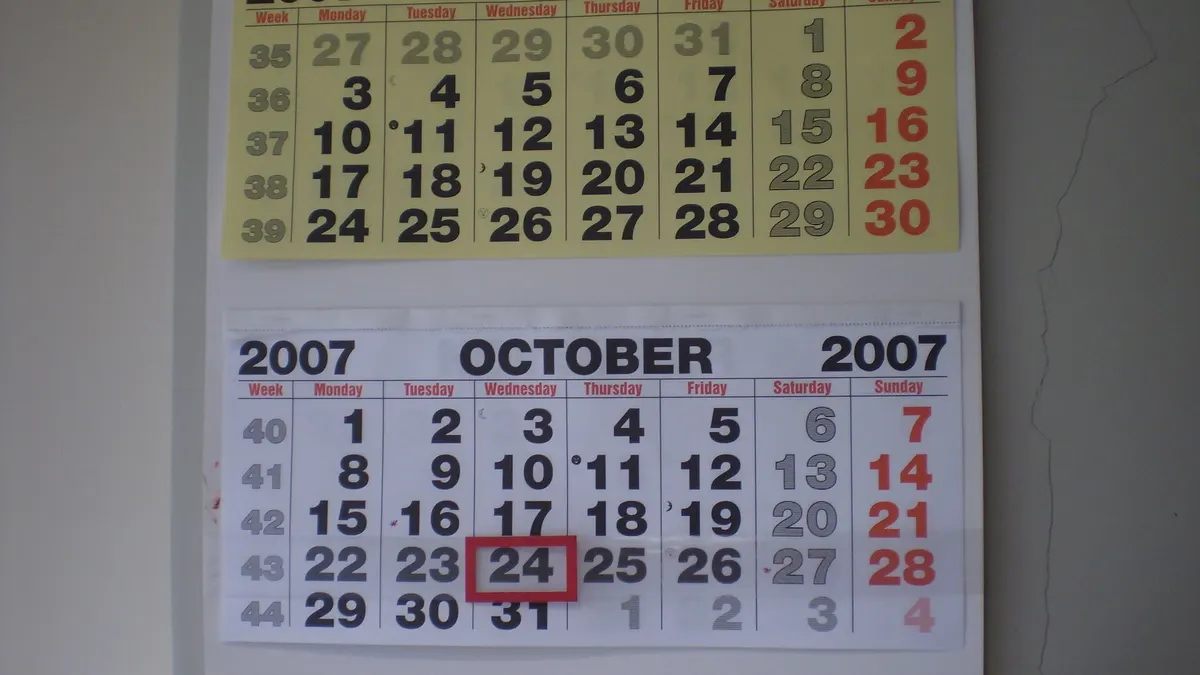
"How many days until the holidays?" sounds like the easiest question in maths. Yet two people with the same calendar often get answers one day apart. The reason has a name, and once you know it you will never miss it again.
The fencepost problem
A fence 10 metres long with a post every metre needs 11 posts, not 10. Calendars work the same way. From Monday to Friday there are 4 days of difference but 5 days if you count both ends. Neither answer is wrong; they answer different questions.
- "How many days until Friday?" means the difference: 4.
- "How many days is the trip, Monday to Friday?" means counting both ends: 5.
Months are not all equal
Thirty days has September, April, June and November; all the rest have thirty-one, except February, which has 28, or 29 in a leap year. Another trick: make two fists and count months across your knuckles and the dips between them. Knuckle months have 31 days; dip months have fewer.
The leap year rule
A year is a leap year if it divides by 4, except century years, which must divide by 400. So 2024 and 2028 are leap years, 1900 was not, but 2000 was. The rule keeps the calendar in step with the Earth's orbit, which takes about 365.2425 days.
Counting a long span quickly
For the days from 1 September to 18 December: September has 30 days, so from 1 September to 1 October is 30. October adds 31 (to 1 November), November adds 30 (to 1 December), and then 17 more days reach 18 December. 30 + 31 + 30 + 17 = 108 days.
Working out an exact age
Count whole years first, then whole months, then days. Someone born on 14 May 2010 has had 16 birthdays by 19 November 2026. From 14 May to 14 November is 6 months, and from 14 November to 19 November is 5 days: 16 years, 6 months, 5 days.
Weekdays and school days
Every block of 7 days contains exactly 5 weekdays. So 15 full weeks hold 75 weekdays, and you only need to check the leftover days by hand. Remember to subtract public holidays and teacher training days when you count school days.
More explainers
 ConvertersUnit conversion without mistakesLearn the "multiply by one" method for unit conversions, the metric prefixes, key US-metric links and how to convert squared and cubed units correctly.
 ConvertersRoman numerals explainedHow Roman numerals work: the seven symbols, adding and subtracting, the six subtraction pairs, reading years like MCMXCIX and where Roman numerals still appear today.
 ChanceProbability basics with dice and coinsLearn probability with dice and coins: favourable over total outcomes, and versus or, the complement trick, independent events and the gambler's fallacy.